Why should I use an automatic transcription software instead of doing it myself?
This is a question that has been raised by many — researchers, students, journalists, podcasters, academics etc. Before we answer it, I would rather clarify “why would I even need to transcribe an interview?”
Transcription is a bridge between data collection and data analysis. Even if it is perceived as boring and is indeed time consuming, it plays a vital role in helping people attain a much better understanding of their participants’ mind, how they think and why.
It allows you to get more familiar with what was discussed in your conversation with interviewee which later becomes helpful in analysing the data more in-depth.
Having said this, the decision to “transcribe or not” depends on your goals, how much time, effort and money you wish to allocate and how deep you need to dive into the source of the conversation. It might be the case that you don’t really need it.
In a scenario where you need to understand the context of your conversation because it will be important later, it would help greatly to have your conversation in a written format. This can become more vital if you are a researcher and need to revisit an old interview — say 3 months after you spoke with the interviewee. Your memory and short notes will not be enough to recall all the details of the interview.
Ok, I need to do it. So what is the best method of doing transcription?
Everybody has a different style, preference or a unique way of doing things, partly due to their habits. Hence the question, “ what is the best method of doing transcription “ is wrongly phrased to begin with.
Many perceive manually writing down hours of conversations to be as boring as hell (including myself). I remember interviewing employees of a large multinational firm as part of an employer branding consultancy project.
Because my time was limited, I had to transcribe hours of interviews on the planes, at the airports, or at other inconvenient places.
It becomes even more time consuming especially if the audio quality is not great or if you are not used to typing fast. Like Barbara Blackburn for instance!
On the other hand, some find it a lot easier to work with audio or video recordings that they transcribe themselves. They feel closer to what the participants meant in a specific context which is completely cool.
Assuming that you need to transcribe an interview, you pretty much have 3 options to choose from:
Each has its own pros and cons but as you can see there is no such a winner to say this is better than the other. As I mentioned above, the decision depends on a variety of factors: available time, deadlines, willingness to put in the effort, money, the size of the team working on the project, the number of interviews and so on.
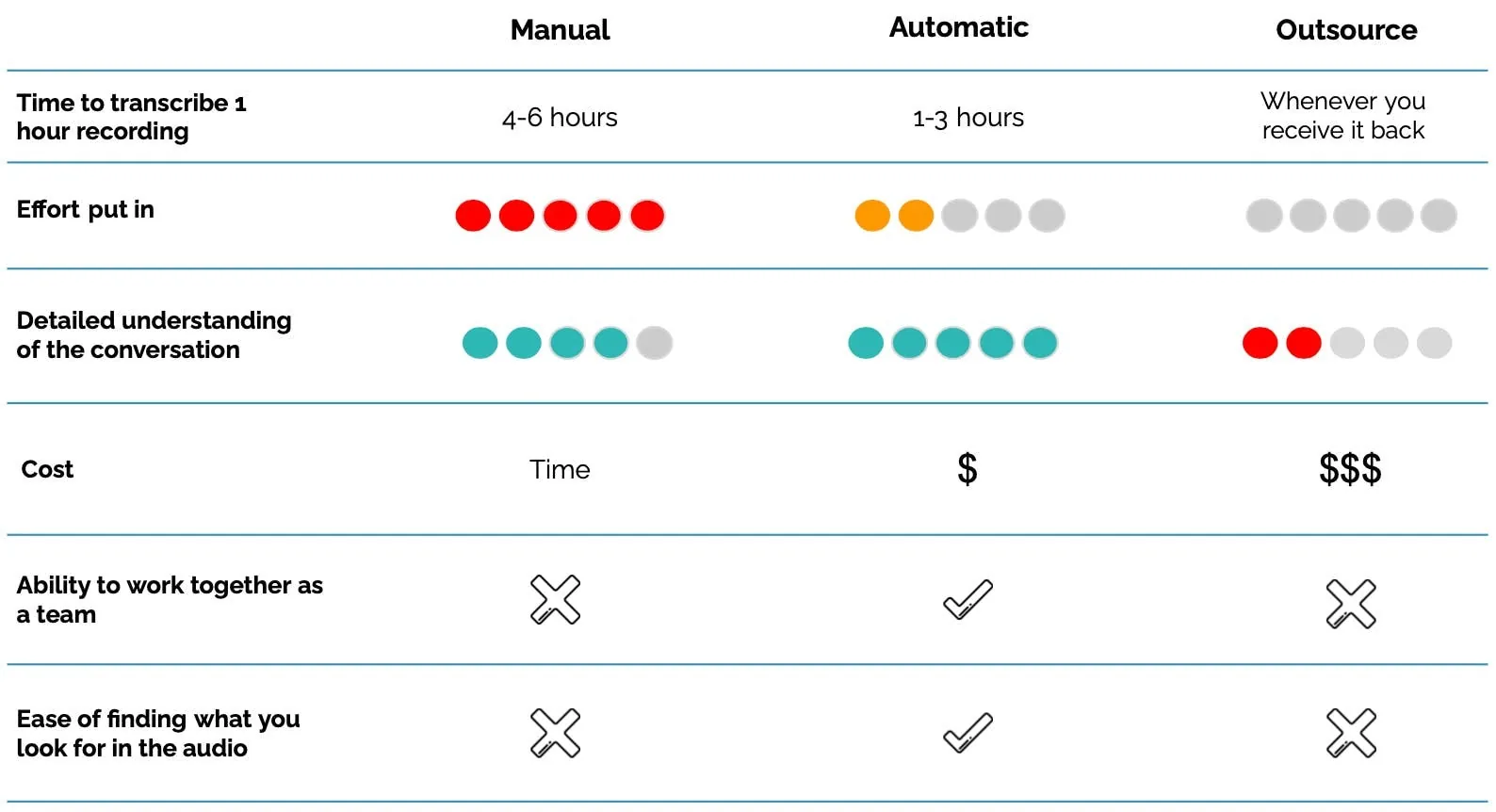
We believe that manual transcription is the best option when
The number of interviews are not that many
You do not have a strict deadline along with other tasks
You have a limited budget
You are just used to it doing it yourself.
Automatic transcription software is the best option when
The audio quality of the recording is good (very important)
You don’t have much time and money to spend on this
You are part of a project team that work together in different locations
You don’t really enjoy spending hours manually transcribing
You know you need to revisit the interview again sometime later and would like to find specific insights very quickly in a structured way.
Outsourcing the transcription of interviews is the best option when
You can afford paying a much higher premium and
You really, really do not like spending a single minute on this task.
Why do I believe an AI-powered software can offer a more effective comprehension of what was discussed in the audio or video?
It is because you can listen and read simultaneously when you are editing the text so this improves your familiarity with the subject. At least that is how I feel. It must have something to do with how my brain functions.
Besides, you can highlight or take notes of those important points only to listen to them later. While saying this, I acknowledge that other individuals might still prefer transcribing manually, partly due to their habits.
If your recording has a good audio quality, transcribing it with an automated transcription software will be the fastest way to get the job done because you can start working on the transcript in just a few minutes. More importantly, the accuracy of the transcription will be quite high so you can be done with editing the text so much faster compared to doing it yourself.
You can save up to 4 hours per a 60-minute video so you can use that time for other important things in your life.
To give you a real-life example, this is how 100 researchers part of the SolPan+ Project coordinated by the University of Vienna, managed to transcribe 500+ hours of interviews across 15 countries in South America by utilising Scrintal.
Assuming approx. 2 hours were saved per interview, using such an automated transcription tool as Scrintal pushed their research project forward by +1000 hours - almost 1.5 months.
If the audio quality is not good however, such algorithms might not save you as much time as you would have hoped. It is true honesty here 😊 Their effectiveness will decrease as the quality of audio gets worse.
If you are interested in learning more about different approaches to transcribing from an academic perspective, I highly recommend Dr. Jaroslaw’s Kruikow’s video on this topic where he discusses “naturalism” and “denaturalism”, and how philosophical worldview has an influence on how to transcribe interviews.