Imagine having a true collective mind of humanity. A true collective knowledge that exists between individuals, and something bigger than the sum of its parts.
This concept draws much attention. However, it is vague and everyone has a different perception. To get a better understanding I firstly break down the concept of knowledge. How do we create knowledge? Then I look into the current ways of sharing knowledge openly, the open-source. Can there be a better way forward? That’s what we are ideating in Scrintal. Jump to the end, if you’d like to see.
Knowledge Creation
We go from data to information and then knowledge.
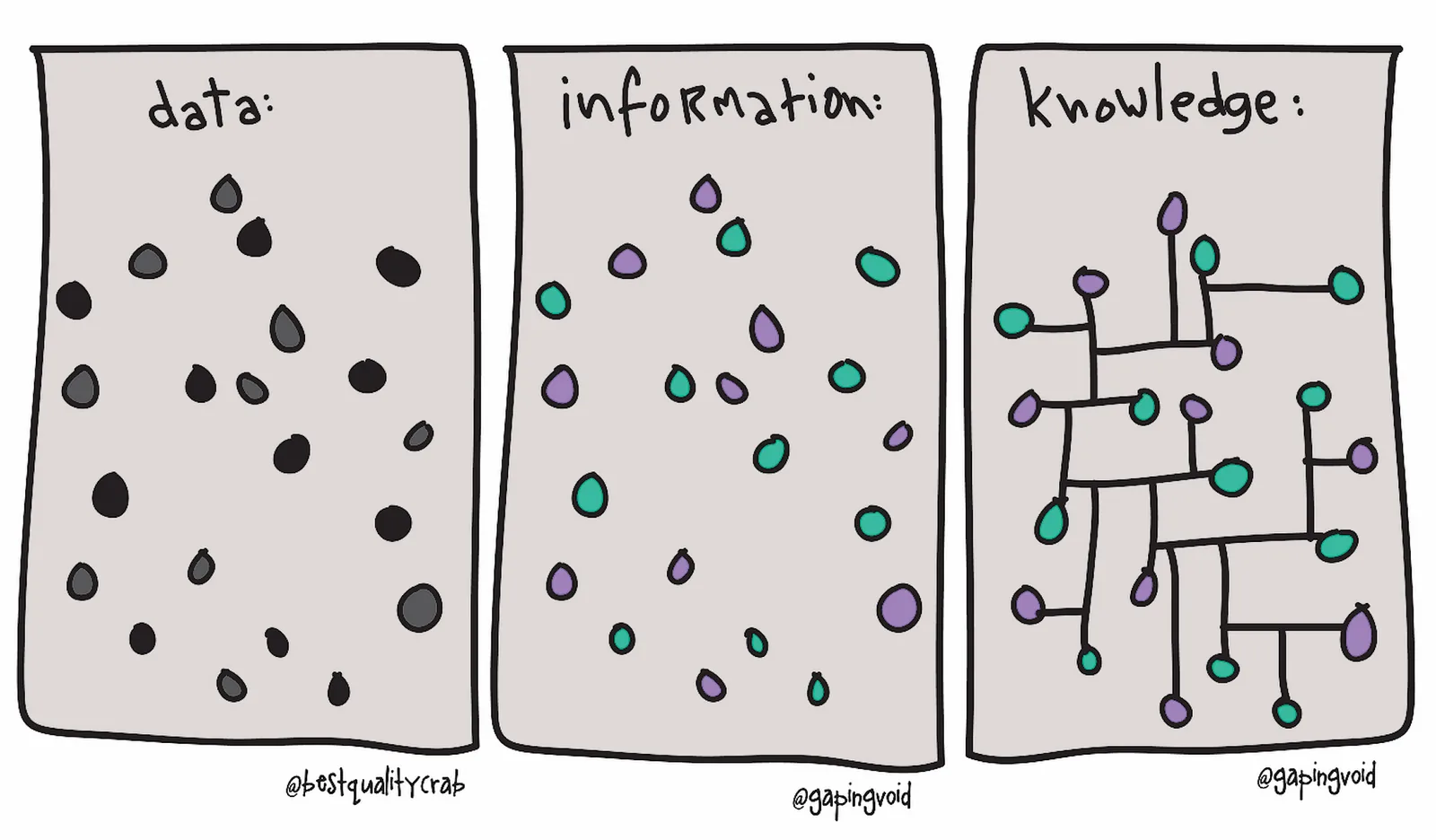
Although some people use the words “data, information, and knowledge” as if they are the same, they are fundamentally different. The journey to create knowledge firstly starts with data. For example, the coordinates of metro stations are data points. This data becomes information when we add additional data about where different train lines are and the city map in which these lines run creates a piece of information as a Metro map for a city.
As a set of different quantities, characters, or symbols, this data exchange is only ever transformed into information once the context of the data is applied. Similarly, information only becomes valuable knowledge when applying additional information and context which connect separate pieces together. From this information, additional context like where one lives and works creates valuable knowledge for the best way to get from one place to another.
In essence, these three aspects are building blocks to each other. Knowledge arises from information, and information arises from data.
Building knowledge is about curating concepts from information that alone would be nonsensical but together creates value and meaning. It’s the process of tying pieces together that would have otherwise remained isolated.

Creating Knowledge is like weaving a carpet, thousands of colorful threads come together to create something new.
Throughout human history, the process of building knowledge has always been in development. From simple stone tools and the discovery of fire to the modern-day era of the internet and automation, humans have consistently created society-progressing knowledge through the connection of different ideas.
This concept; however, changed dramatically with the introduction of open source.
Open Source, Today
Fast forward to today, the term “open source” is part of a broader movement of open collaboration, sharing the processes as they are being created, allowing for the exchange of ideas between creators and outside individuals for mutual benefit. We can see this concept across three main fields below.
1. Open-source code
Arguably the most well-known form of open-source information is open source code. Via open-source platforms, individuals in the programming industry can easily collaborate with others and merge and track changes to their code. Rather than reinventing the wheel, open-source code revolutionized the programming industry, promoting universal access to product blueprints and design and accelerating technological progress.
The scalability and applicability of open source code are incredible, but the applications of this knowledge have hardly broken out of the niche of the computer programming industry. Even though the utility of this process can be seen directly, it’s hardly touched the surface of other knowledge-creating fields. It’s simply not widely used across other fields and domains.
2. Open-source information
The internet today is filled with open-source information exchange. Free of cost and at the edge of one’s fingertips, millions of people are sharing information on and pulling information from the deep depths of the world wide web. The internet as it stands is a place where the public can contribute and gain information without barriers to access.
One of the most common examples of this is Wikipedia. Designed to be a platform for open editing and sharing to provide useful information on a range of topics, the site now holds a total of over 6 million articles, with an average number of new articles added close to 600 per day.
Despite its relevance and utility, both the Internet and Wikipedia share one common problem: it’s a mess of information out there. The information you are seeking can be easily accessed, but to develop that open-source information into valuable knowledge, it’s still difficult to synthesize. The processes in which people are using the information to create knowledge are hidden within the cracks.
3. Sharing patents
More recently, companies and governments have also seen the benefit of providing data and information to the public as open-source material. In local governments, in particular, the movement for smart cities has open data exchange as a pillar, providing essential services and other city functions more efficiently than ever before. For example, one application called Blindsquare provides audio directions and a variety of other features for visually impaired individuals to navigate their surroundings, successfully developed from open-source data in Foursquare and OpenStreetMaps.
Tesla has opened up their electric vehicle technology patents to outside individuals, in response to the realization that Tesla alone could never solve the global transportation emissions problem.
Like open-source information, these trends for open source exchange in varying organizations still hide the process of creating behind the closed doors of the internet.
A Better Way Forward?
How can we address the global impacts of issues such as climate change, conflict & migration, public health, poverty, and equity, without progressing knowledge and paving a way for open and equitable access to that said knowledge?
Pushing for open knowledge creation means breaking down the barriers that prevent outsiders from being left out. It democratizes the knowledge creation process while also stimulating innovation and pushing society forward.
To us, the first step to achieving this mission is creating Scrintal. A way to make knowledge more connected, accessible, and open. Scrintal is defining a new category for knowledge work, designed by researchers to empower all creators, thinkers, students, and learners.
Whether you are an academic, or an entrepreneur striving to solve some of the world’s biggest problems, we believe that there is an easier path for you to create and build upon open & accessible knowledge around the world.
👾🕹️👾 You choose what’s next:
[1] Read why we started Scrintal
[2] Check out what we’re building — Scrintal
[3] Calling all innovators — We’re hiring!
[4] Aligned with our purpose? Get in touch with us at hello@scrintal.com