How can you describe Scrintal? This question haunted us. We iterated countless times but had no luck describing everything in a single line. Now, we say Scrintal is a visual space combining canvasses and docs. The hardship in defining Scrintal, as I mentioned in my Scrintal’s Philosophy and Roadmap post, comes from the fact that Scrintal brings two separate worlds together, the visual and text-based. It would have been easier to describe Scrintal if it had been a note-taking tool or if it had only been a visual tool.
As difficult as it is to describe Scrintal in one sentence, it’s easy to talk about the parts of the product that make it unique.

1.Overview Effect
The overview effect is a cognitive shift in awareness reported by some astronauts during spaceflight, often while viewing the Earth from orbit. It usually involves realizing the bigger picture of our existence and the minor, the almost negligible scale of human life in comparison to the vastness of the universe.
As unusual as it may sound, “Wow, I have the overview effect now” was the first reaction when one of the first ten alpha testers saw Scrintal. This was the reaction we hoped for, as when we first designed Scrintal with a canvas, we didn’t design a canvas for casual brainstorming. On the contrary, the canvas was essential to creating a sense of seeing the bigger picture — to see the trees and the forest at the same time…
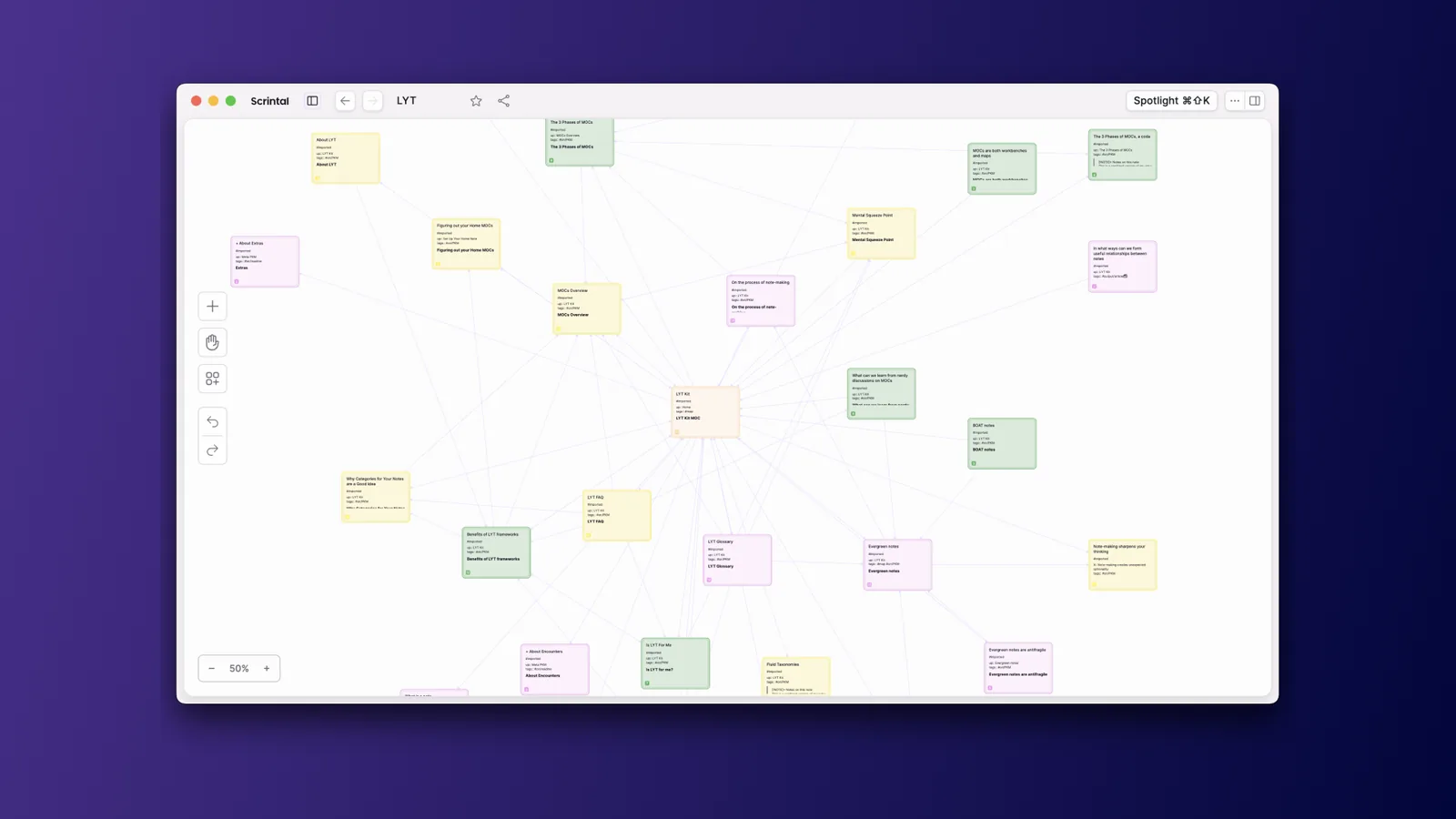
Infinite canvas
Especially when cards convey individual ideas with meaningful titles, one gets the feeling that one can see what matters the most at one glance. Our concept from the start was to create a space to fit everything we need to complete our work physically into one canvas. We found the answer by making the canvas the fundamental pillar of our design. Having a canvas as the primary workspace eliminates the context switch and going back and forth across the multiple tabs.
Having a visual “space” inspired by the overview effect is to transform the way we interact with our work and ideas. It aims to mirror astronauts’ transformative experience when viewing Earth from space. A Scrintal user is encouraged to see beyond the minutiae of individual tasks and grasp their projects’ interconnectedness and overall direction. The canvas becomes not just a tool for organization but a medium for experiencing the cognitive shift that highlights the importance of the bigger picture. Just as the overview effect compels astronauts to reconsider their relationship with the Earth and humanity, with Scrintal, we invite users to step back, reflect, and appreciate the broader context of their ideas.
2. One Global Archive
Another design decision that makes Scrintal unique is the one global archive. Scrintal’s central concept is that cards are permanent entities, singular and reusable. Each card goes to a single archive, letting the user search and reuse the cards across different boards and, thus, other contexts.
This fundamental design decision contrasts with the temporary nature of the visual tools. The global archive is a remarkable, unique point in Scrintal. Bringing the canvas and the archive together made the marriage of the visual and permanent possible.
Scrintal has a global archive
We see our cards like lego pieces. Each card is small but full of essential details and stands on its own. Just like lego, these cards can be used over and over again. Imagine using the same lego block to build many different kinds of castles. This idea shows how flexible and adaptable our system is, letting you use the same essential pieces to assemble all sorts of projects. It’s like having a toy box where you can mix and match pieces to make whatever you can think of, making it easier and more fun to work on your ideas.
3. Bidirectional Links
In Scrintal, a unique feature is creating bidirectional links through in-text writing and visually on the canvas. This feature gives the user a unique way to see how the ideas are connected, not just by noting them down but also by drawing these connections directly. It’s a straightforward approach to mapping out the relationships between the thoughts, making each link a visible part of one’s work.
Using these links, one can easily navigate from one idea to another, linking the thoughts in a natural flow. This is based on our initial concept of making cards more than just standalone pieces of information. By allowing them to interact, we help piece together a giant puzzle, where each card is a critical node in a network of interconnected ideas.
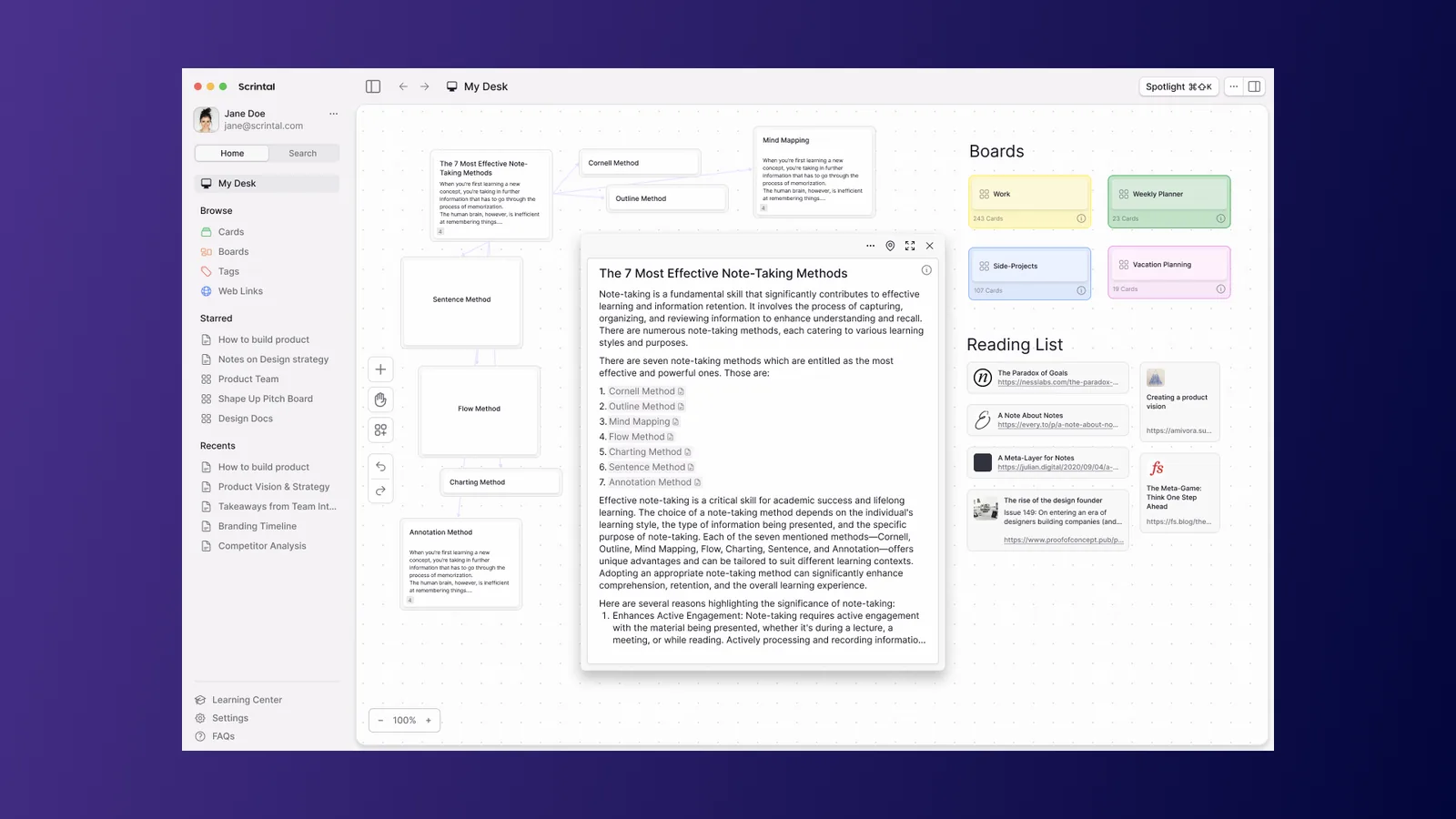
Bidirectional links bring visuality and permanence together
Creating bidirectional links visually and in-text makes it easier to track thoughts and their connections. Whether you’re deepening your understanding of a topic or brainstorming new ideas, having a visual map of how everything ties together decreases the mental burden.
In Scrintal, the user can use whichever method suits their thinking style best, whether they’re more inclined to write down the thoughts or prefer visually drawing out the connections. It’s all about making the organization of ideas as intuitive and accessible as possible!
4. Open Card Windows
Scrintal features open card windows. Simply double-clicking on a card opens a new window, allowing users to dive into the card’s content while still navigating the expanse of the canvas. This functionality mirrors the ease of flipping through pages in a book, ensuring that insights and ideas remain accessible as you explore different sections of your workspace.
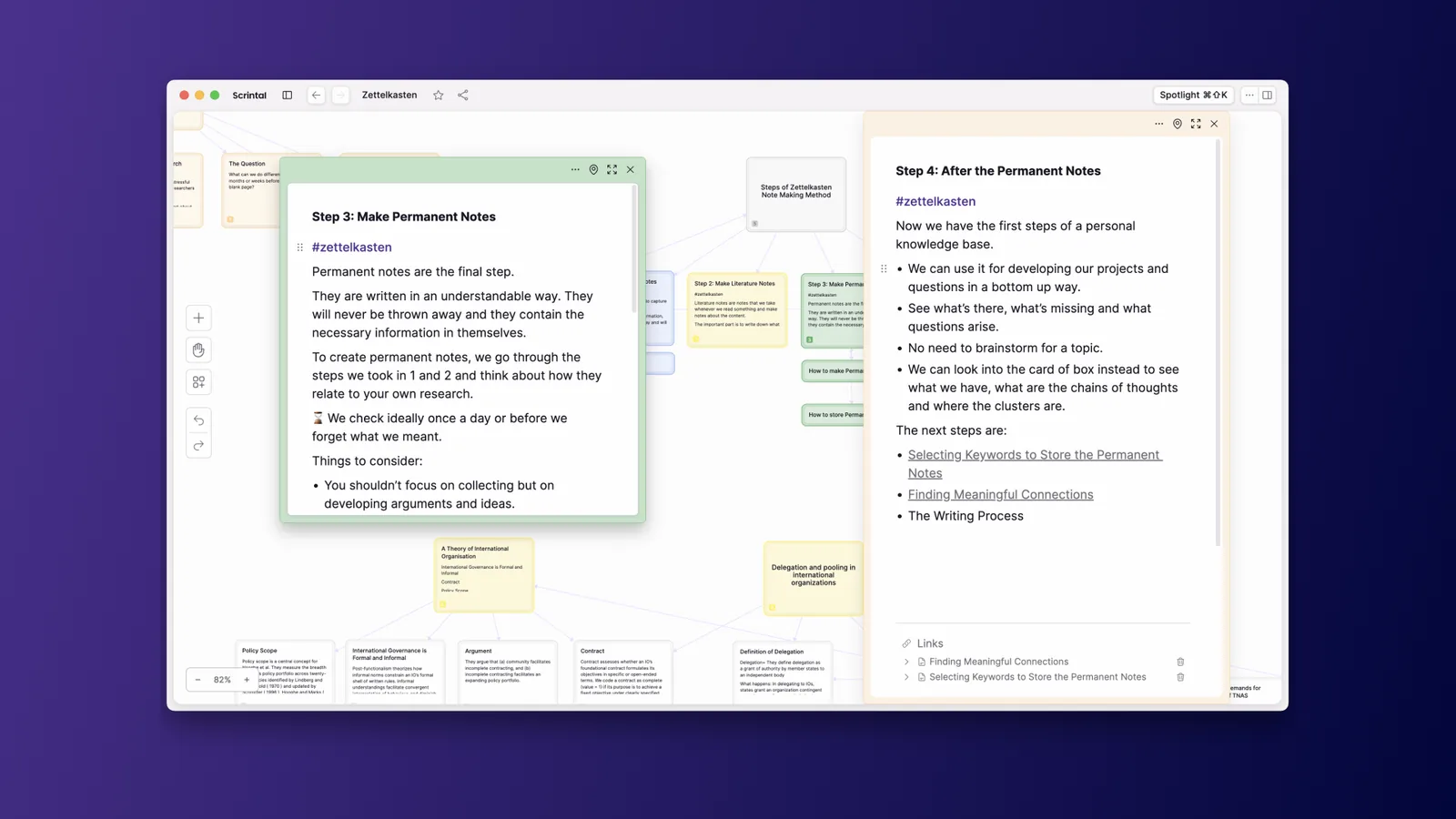
Scrintal’s open card windows
We intentionally embraced this design to streamline the journey from one thought to the next, fostering an environment where thoughts can roam freely. This approach is about making it effortless for users to connect the dots between their ideas, encouraging a seamless exploration of thoughts without interrupting the creative process.
Opening multiple cards simultaneously ensures that users can juxtapose various ideas on a single screen, maintaining a continuous flow of thought. This aspect of Scrintal’s design underscores our commitment to preserving the fluidity and adaptability of the creative process, ensuring that users can engage with their work in a natural and unrestricted way.
5. Scrintal is Browser-based
As another fundamental decision, we prioritized building Scrintal in the browser environment. This decision means certain gains and sacrifices.
The fact that Scrintal lives in the browser makes the app accessible no matter where or what device you use. Like how we view our cards as individual lego blocks, rich with information and standalone in nature, Scrintal is a platform built for flexibility and ease of access. Whether on your phone or tablet, you can dive into Scrintal through your browser and pin it as a shortcut on your home screen, ensuring that your workspace is a tap away.
Scrintal on tablet
Interacting with Scrintal on a tablet, especially with a pencil, feels almost like playing. Each pencil movement, whether dragging cards across the canvas or jotting down thoughts directly into them, feels fluid. This tactile experience enhances the way we engage with information, mirroring the simplicity and joy found in snapping some blocks physically together.
The real beauty of Scrintal, being browser-based, unfolds in the collaborative space it creates. Unlike desktop apps, Scrintal allows for real-time collaboration on boards and cards, enabling a seamless flow of ideas and adjustments among team members.
👾🕹️👾 You choose what’s next:
[1] Check out what we’re building — Scrintal
[2] Follow our updates on X ✨